Reunion at the chapel
Down Cemetery RoadThe reunion at the chapel is the point at which Sarah Trafford’s search for Dinah reaches Michael Downey and the child herself. A place Michael had once shared with Tommy Singleton as a hiding place becomes, years later, a refuge again—and the setting for Sarah and Dinah’s first meeting.
Finding the Chapel
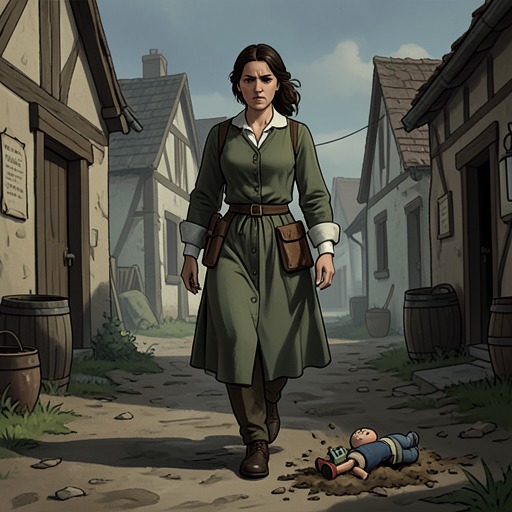
Sarah recognizes the location through a memory rather than a promise. Michael had talked about the chapel when he and Tommy Singleton escaped; this was where they had hidden. Once Sarah remembers, she insists to Zoë that she knows where they are. Their route leads to a chapel by a wood, a little way up the coast, which Sarah describes as deserted and recalls as the sanctuary where they sheltered on their first night. What was once an improvised refuge for two escapees has become the place where Sarah expects to find Michael and the missing child.
The Chapel Door
Crossing the threshold does not bring Sarah into uncomplicated safety. The bare interior recalls the chapel at The Arimathea Home, where she had first gone looking for Dinah, and the old, stone-locked air brings the accumulated violence of her life into the present. Her memory breaks into bright, abrupt images: a house collapsing, sparks rising into the dark; a man bleeding at his desk; another trying to kill her with dental floss; and her own fall from a roof years before, lights wheeling around her. The chapel gathers these separate dangers into one passage of time. Sarah sees herself still moving through each moment in turn, now searching for a girl who, like her, has survived.
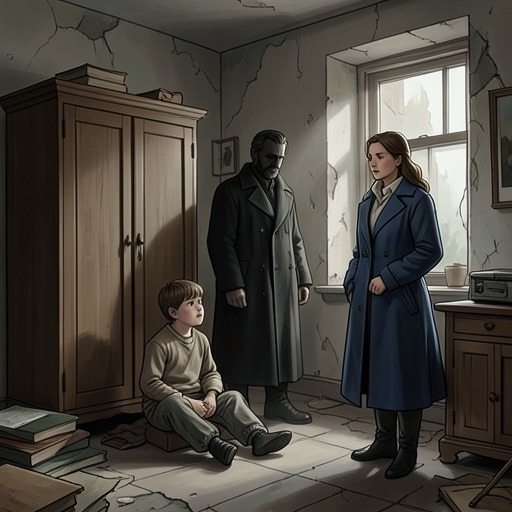
The present scene is starkly spare: no benches, altar, or other furniture, only a filthy stone floor, cracked windows, and low, bare beams. Against the wall sits Michael Downey, holding Dinah. He has a gun trained on Sarah. For an instant she imagines the future collapsing into the shot—his firing, her fall, the world going black—but that feared outcome does not occur. Michael lowers the gun as Sarah emerges from the shadows, raises it again when he sees Zoë behind her, then puts it down once more. Zoë is armed too, yet the immediate standoff gives way without a shot. Michael looks exhausted, as though nearly half dead, and the meeting begins not with explanation but with the two women confronting the danger and fatigue that have brought them to him.
First Contact
Sarah steps past the armed standoff and crouches beside Michael to look at Dinah. The child is awake: a small blonde girl with large green eyes, who studies Sarah without blinking before turning her face into Michael’s chest. Michael observes that Dinah looks like Maddy Singleton; Sarah answers that the girl is beautiful. The brief exchange shifts attention from the guns and the danger outside to the child herself, whom Sarah has crossed so much distance to find.
Sarah holds out her arms, but Dinah initially remains nestled against Michael as if she trusts him to keep her safe. Her mother is dead, and Dinah does not yet know it; Sarah recognizes that the child has no reason to understand the journey that has brought her here. She tells Dinah she can stay where she is. Then Dinah wriggles in Michael’s arms and reaches both hands toward Sarah, making the choice Sarah had not presumed to ask of her.
Sarah sets the teddy bear down in the dust and lifts Dinah. The transfer registers as weight and warmth, and as the immediate physical reality of a child: working lungs, an empty stomach, the need for food and sleep. Sarah can offer only a moment’s peace, not undo what has happened or meet every need at once. When Dinah points at the bear and remarks, “That man again,” the small object remains part of the reunion’s close, uncertain present: the child is in Sarah’s arms, but the world she has endured is not yet fully known to her.
A Reunion Without Resolution
The encounter answers the immediate question of where Dinah is, but it does not make the dangers that brought Sarah Trafford there disappear. Its decisive change is relational: a search conducted across memories of violence becomes direct responsibility for a living child, while Dinah’s gesture establishes a connection that no explanation could have secured in advance. The scene therefore closes one uncertainty and opens another. Sarah has found Dinah; what the child has endured, and what care will require, remain beyond this first meeting. The chapel offers no return to an undamaged past, only a brief point of contact from which the next part of their lives must proceed.